



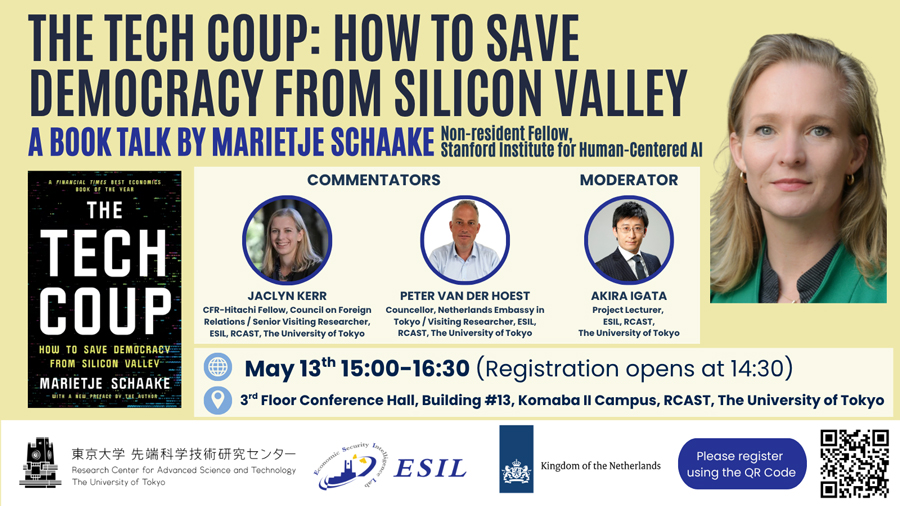
The Tech Coup: How to Save Democracy from Silicon Valley
Details
| Type | Lecture |
|---|---|
| Intended for | General public |
| Date(s) | May 13, 2026 15:00 — 16:30 |
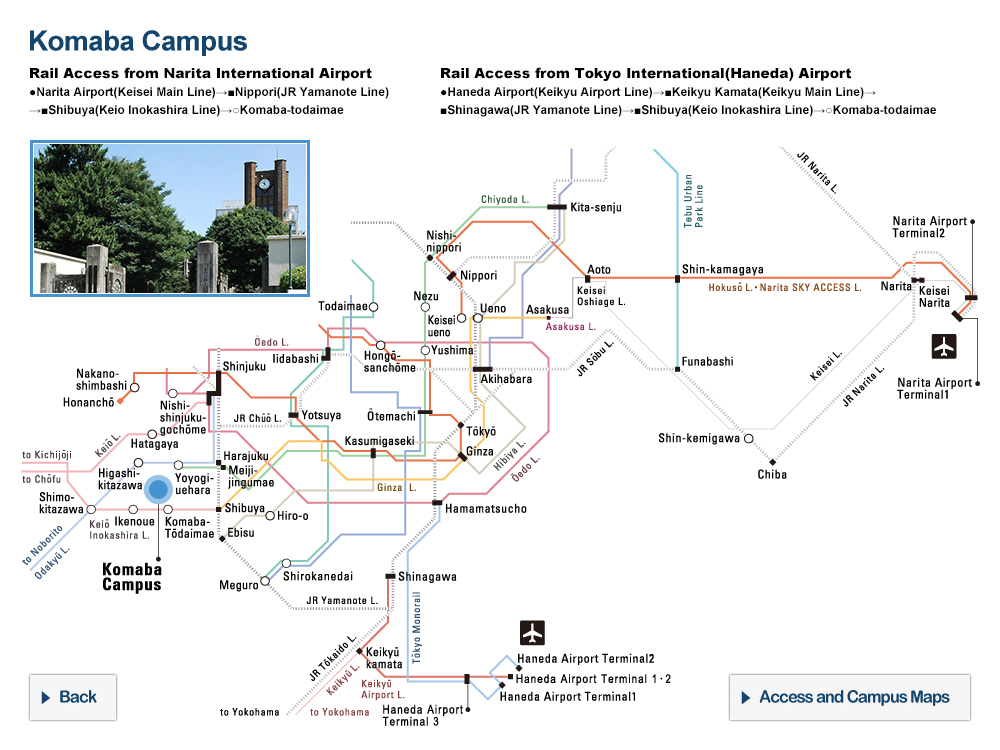
| Location | Komaba Area Campus |
| Venue | 3rd Floor Conference Hall, Building #13, Komaba II Campus, Research Center for Advanced Science and Technology, The University of Tokyo |
| Capacity | 80 people |
| Entrance Fee | No charge |
| Registration Method | Advance registration required
Please register via Google form |
| Registration Period | May 4, 2026 — May 12, 2026 |
| Contact | akira-igata@g.ecc.u-tokyo.ac.jp |
The Economic Security Intelligence Lab (ESIL) at the Research Center for Advanced Science and Technology (RCAST), The University of Tokyo, and the Embassy of the Kingdom of the Netherlands in Japan are pleased to host a public book talk titled:
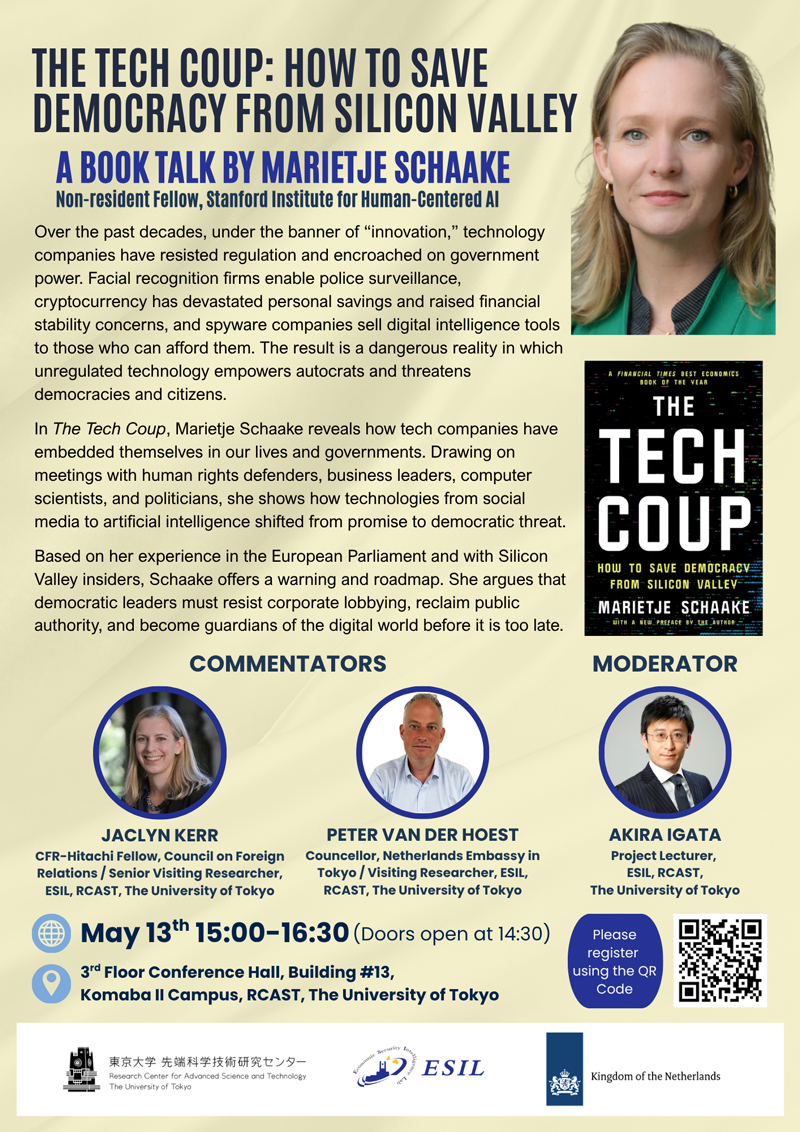
The Tech Coup: How to Save Democracy from Silicon Valley
【Event Overview】
Over the past decades, under the cover of “innovation,” technology companies have successfully resisted regulation and have even begun to seize power from governments themselves. Facial recognition firms track citizens for police surveillance. Cryptocurrency has wiped out the personal savings of millions and threatens the stability of the global financial system. Spyware companies sell digital intelligence tools to anyone who can afford them. This new reality—where unregulated technology has become a forceful instrument for autocrats around the world—is terrible news for democracies and citizens.
In The Tech Coup, Marietje Schaake offers a behind-the-scenes account of how technology companies crept into nearly every corner of our lives and our governments. She takes us beyond the headlines to high-stakes meetings with human rights defenders, business leaders, computer scientists, and politicians to show how technologies—from social media to artificial intelligence—have gone from being heralded as utopian to undermining the pillars of our democracies. To reverse this existential power imbalance, Schaake outlines game-changing solutions to empower elected officials and citizens alike. Democratic leaders can—and must—resist the influence of corporate lobbying and reinvent themselves as dynamic, flexible guardians of our digital world.
Drawing on her experiences in the halls of the European Parliament and among Silicon Valley insiders, Schaake offers a frightening look at our modern tech-obsessed world—and a clear-eyed view of how democracies can build a better future before it is too late.
【Speaker】
Marietje Schaake is the Non-resident Fellow at Stanford’s Institute for Human-Centered AI. As a member of European Parliament from 2009 to 2019 from the Netherlands, Marietje has been a top figure shaping Europe's policies on technology, trade, and foreign affairs. Among her achievements, she helped to launch “net neutrality” policies now in force across Europe, and she advanced several initiatives to promote digital freedoms, including stricter export controls for cybersurveillance technology, and new policies for e-commerce and cybersecurity. Marietje was also part of EU delegations to the US, Iran, and the Arabian Peninsula, as well as the chief observer to the election mission in Kenya. She was named one of the “Most Influential Europeans” in Politico's Class of 2017.
【Commentator】
Jaclyn Kerr is a CFR-Hitachi Fellow at the Council on Foreign Relations and a Senior Visiting Researcher at ESIL, RCAST, The University of Tokyo for the year of 2026. She is a Professor at the College of Information and Cyberspace (CIC), National Defense University. Her work focuses on digital and emerging technologies and their current and future impacts on international politics, national security, and democracy. She has conducted research and taught on the digital politics of authoritarian regimes, the role of information technologies in civil society and protest mobilization, cyber domain strategy, global Internet governance, the role of artificial intelligence in national security and foreign policy, and on the role of digital technologies in the politics of Russia, China, and Eurasia.
Peter van der Hoest is a Counsellor at the political section of the Netherlands Embassy in Tokyo and a Visiting Researcher at ESIL, RCAST, The University of Tokyo. Peter completed his PhD (International Relations) at the National Graduate Institute for Policy Studies (GRIPS) in Tokyo and his MA (History) at Utrecht University. Through various postings within the Dutch government Peter has gained extensive experience on topics related to national and economic security. As a Visiting Researcher at the University of Tokyo, he is primarily looking at economic security from a historical perspective, with a focus on the mid-19th century, drawing on the unique relationship between Japan and the Netherlands.
【Moderator】
Akira Igata (Project Lecturer, RCAST, The University of Tokyo)
This symposium will be conducted in English.
Notes for participants
- For security reasons, no dangerous materials or food/beverages are allowed inside the venue. Please follow staff instructions during the event.
- Please present your valid photo ID (e.g., student ID or driver’s license) at the reception desk on the day of the event. For security reasons, participants who do not provide complete and accurate information regarding their identity, affiliation, and position may not be admitted.